How to design a revenue-maximizing auction where multiple bidders are incentivized to report their values truthfully? And how to handle discontinuous utility functions that arise when agents best-respond in contract and persuasion settings?

GemNet [EC 2024]
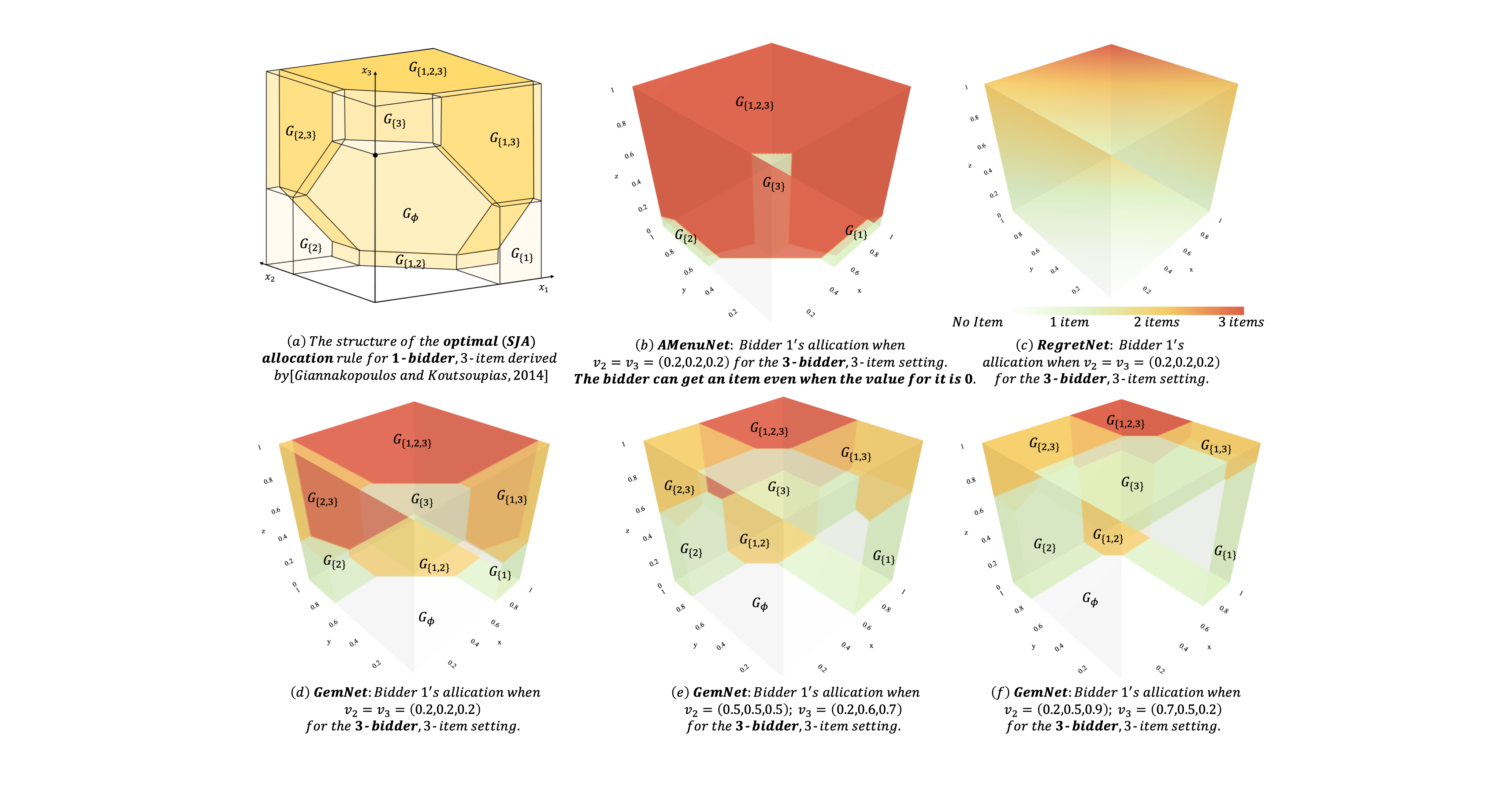
Read paperWe introduce GEneral Menu-based NETwork (GemNet), the first strategy-proof and general auction that supports multiple bidders.
We hope GemNet can shed light on theoretical analysis: it shows that multi-bidder auction designs can be similar to analytically optimal designs of their single-bidder counterparts. See figures below.
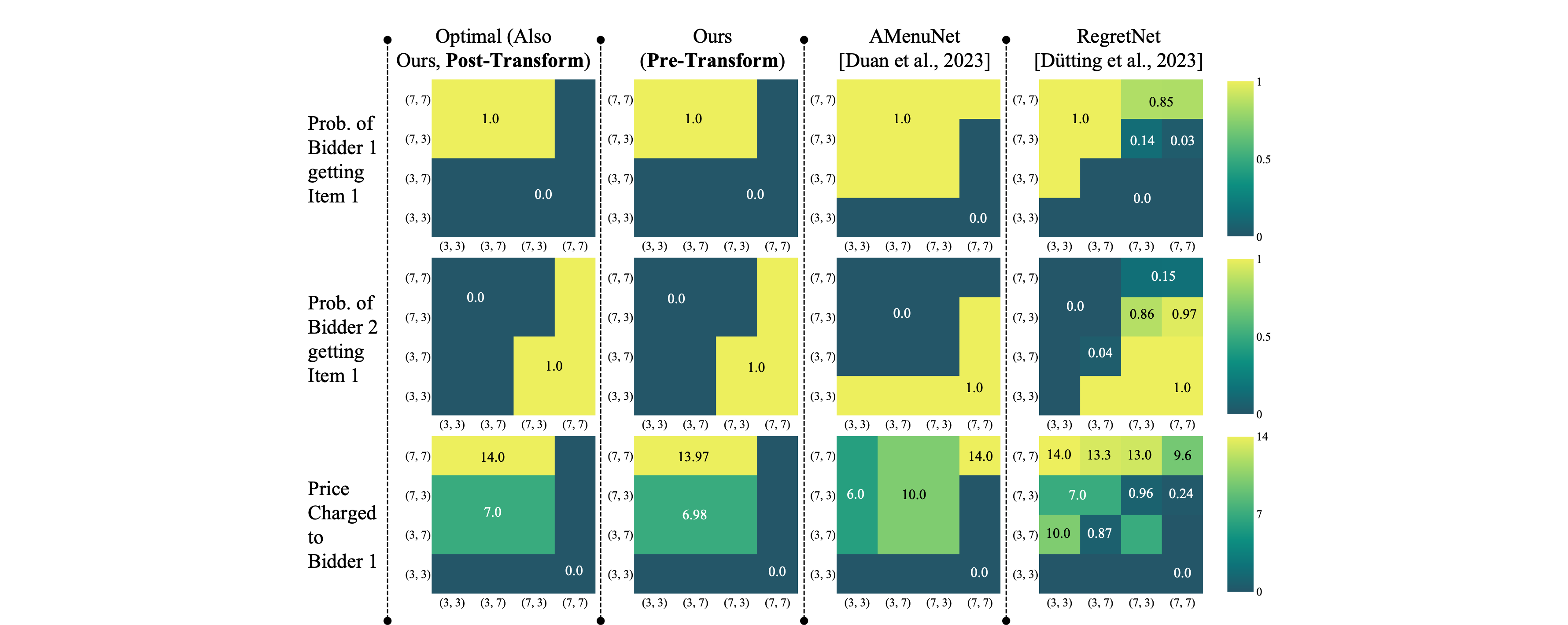
Our method reproduces the optimal auction in the setting with 2 additive bidders, 2 items, and valuations on support size two [Yao, 2017].
Piecewise Linear, Discontinuous Network
PaperEconomics assumes that agents are best responding. When best responses change, utilities may change discontinuously. We develop discontinuous networks to handle these cases.
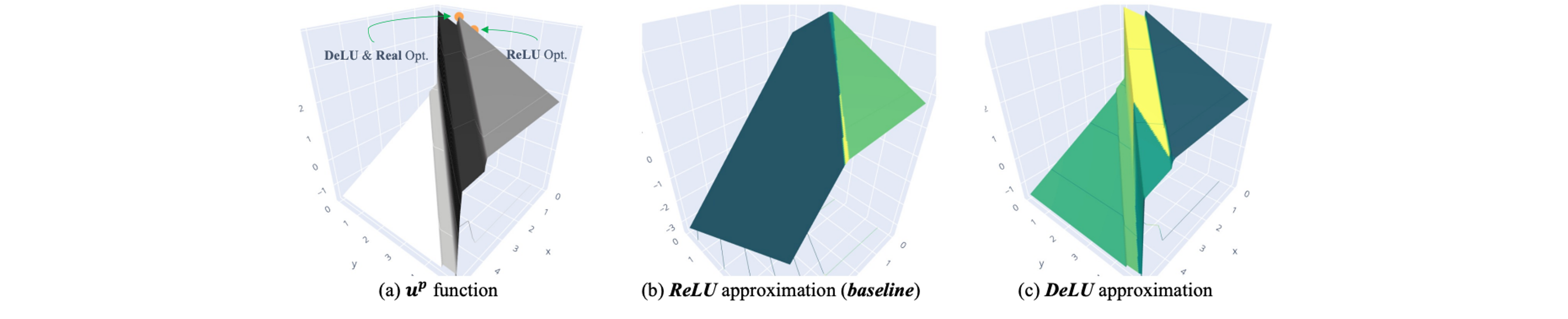
Designed for contract design, where the utility function is piecewise linear but discontinuous. [NeurIPS 2023]
For the figure below: (a) The exact surface of the principal's utility function. (b) A learned ReLU network cannot model the discontinuity and yields an incorrect contract. (c) A learned DeLU network represents a discontinuous function and well-approximates the ground-truth.
Piecewise Non-Linear, Discontinuous Network
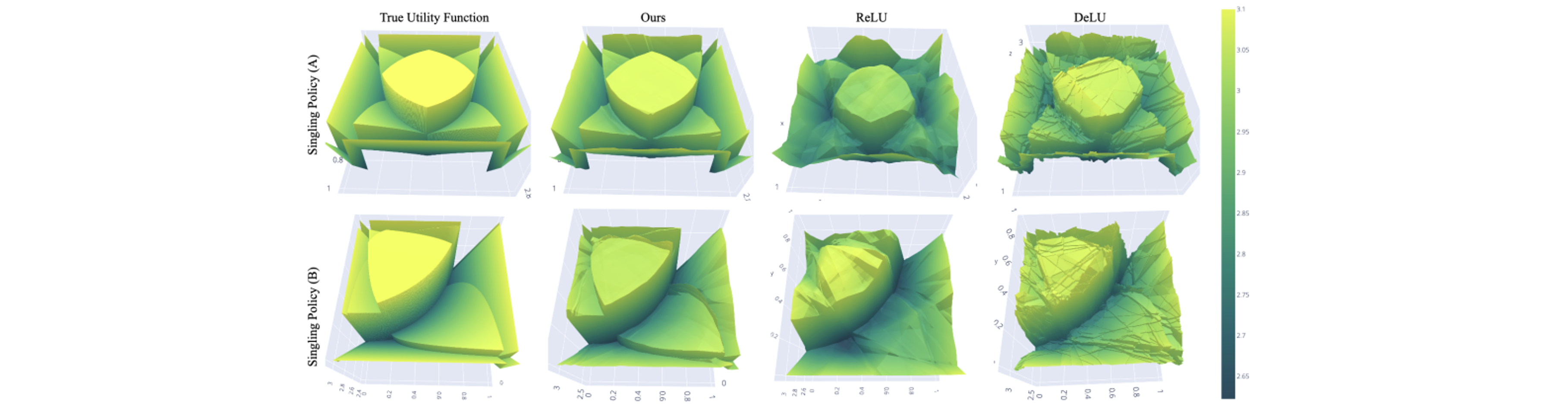
PaperDesigned for multi-sender persuasion, where the utility function is piecewise non-linear and discontinuous. [ICML 2024]
In each column below, we show the ground-truth principal's utility and the approximation results achieved by our method, ReLU, and piecewise linear discontinuous networks, respectively.